Coordinating Retail Device Networks with Remote Accounting Platforms for Record Consistency
Written by Xander Sullivan · Jun 19, 2026

Coordinating Retail Device Networks with Remote Accounting Platforms for Record Consistency
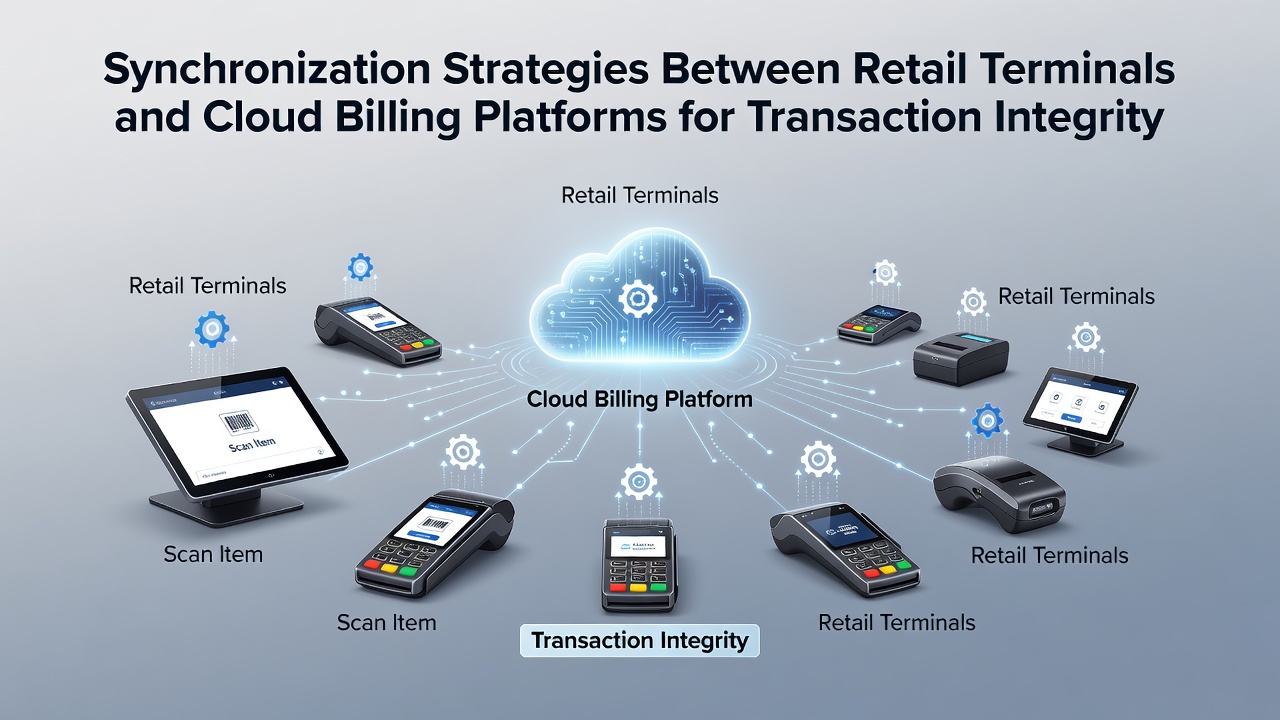
Retail terminals generate transaction records that must reach cloud billing platforms without loss or alteration, and observers note that various synchronization approaches address this requirement through scheduled transfers, event-driven updates, and hybrid models. These methods operate across wired and wireless connections while maintaining sequence integrity during high-volume periods such as holiday rushes or promotional events. Research indicates that mismatched timestamps or duplicate entries often arise when latency spikes occur, prompting operators to implement sequence numbering and checksum validation at each handoff point.
Batch synchronization remains common in environments where continuous connectivity proves unreliable, and data shows that terminals collect records locally before transmitting them during off-peak windows. This approach reduces bandwidth demands yet introduces delays that can affect real-time reporting dashboards used by finance teams. Event-driven synchronization, by contrast, pushes each completed transaction immediately upon authorization, and studies reveal that this pattern supports faster reconciliation when paired with acknowledgment packets returned from the cloud layer.
Core Technical Mechanisms
Message queuing systems buffer outgoing records during temporary outages, and those who manage large terminal fleets report that queues prevent data loss while allowing orderly retransmission once connectivity resumes. Conflict resolution rules determine which version prevails when the same transaction arrives from multiple paths, and protocol specifications typically rely on unique identifiers plus timestamps to establish precedence. Compression and encryption layers travel alongside the payload to protect confidentiality without adding excessive overhead that might slow smaller devices.
Database replication techniques mirror transaction tables between terminal caches and central ledgers, and figures from industry benchmarks demonstrate that incremental replication cuts transfer volumes compared with full dumps. Version vectors track changes across distributed nodes so that platforms can detect and merge concurrent updates without overwriting legitimate entries. Observers note that these vectors become particularly useful when mobile terminals move between network cells and experience brief disconnections.
Handling Disruptions and Recovery
Network partitions occur during storms or infrastructure maintenance, and terminals switch to local storage modes until links stabilize. Automated retry logic with exponential backoff prevents thundering herd problems when thousands of devices attempt reconnection simultaneously. In June 2026, updated guidelines from standards bodies emphasized testing recovery sequences under simulated multi-hour outages to verify that no records fall through gaps.
Transaction logs written to tamper-evident files provide an audit trail that survives even complete platform restarts, and auditors routinely compare these logs against cloud records to confirm completeness. When discrepancies surface, delta comparison tools highlight missing or altered items so that operators can trigger targeted resends rather than full reloads.
Standards and Implementation Patterns
ISO specifications outline message formats and security requirements that many vendors follow when designing terminal-to-cloud interfaces, and compliance reduces integration friction across mixed hardware environments. Heartbeat signals confirm ongoing connectivity, while health checks verify that both endpoints agree on the last successfully processed sequence number. Those who deploy large-scale systems often combine these signals with circuit-breaker patterns that temporarily halt traffic when error rates exceed defined thresholds.
According to documentation from NIST publications on data integrity, cryptographic hashes appended to each record allow quick detection of any modification during transit. European regulatory frameworks similarly require demonstrable audit trails for payment-related data, and operators reference these rules when selecting synchronization libraries and scheduling policies.
Operational Monitoring and Metrics
Latency histograms track the time between transaction capture and cloud acknowledgment, and teams set alerts when percentiles drift beyond historical baselines. Throughput counters measure records processed per minute across regions, revealing imbalances that might indicate regional network congestion or configuration drift. Error categorization separates transient failures from persistent ones so that support staff can prioritize root-cause analysis accordingly.
Capacity planning exercises project growth in transaction volumes and test whether current queuing depths and bandwidth allocations remain sufficient. Simulation environments replay historical traffic patterns against staging platforms to surface bottlenecks before they appear in production. Observers note that organizations running such exercises experience fewer synchronization incidents during peak seasons.
Conclusion
Synchronization between retail terminals and cloud billing platforms rests on a combination of queuing, validation, replication, and monitoring practices that together preserve record accuracy across variable network conditions. Continued refinement of these techniques supports reliable transaction flows as device counts and data volumes increase over time.