Mapping Currency Corridors: How Merchant Frameworks Stabilize Recurring Mobile Charge Sequences
Written by Felix Meier · Jun 14, 2026
Mapping Currency Corridors: How Merchant Frameworks Stabilize Recurring Mobile Charge Sequences
Observers note that currency corridors function as defined pathways through which funds travel between different monetary zones, and merchant frameworks serve as the structural anchors that keep recurring mobile charge sequences consistent even when exchange rates fluctuate. Research from multiple central banks shows these frameworks incorporate automated conversion protocols, settlement buffers, and risk-allocation rules that activate during each billing cycle. Data from cross-border transaction logs indicate that merchants who deploy layered account structures experience fewer interruptions in subscription renewals compared with those relying on single-currency processing. The corridors themselves emerge from agreements among acquiring banks, card networks, and mobile operators, and they specify which currencies may enter or exit at each node. In practice, a merchant account set up in one jurisdiction receives authorization requests denominated in another currency, then routes the value through an intermediate ledger that applies real-time exchange rates before crediting the merchant’s primary balance. This sequence repeats at fixed intervals for mobile subscriptions, and the framework’s stability derives from pre-funded liquidity pools that absorb short-term rate movements without triggering declines.Core Components of Merchant Frameworks
Merchant frameworks consist of several integrated elements that operate in sequence during every recurring charge. Authorization gateways first validate card details and currency compatibility, then forward requests to currency-conversion engines that reference live market feeds. Settlement engines subsequently move cleared funds along the corridor, while compliance modules apply jurisdiction-specific rules for reporting and tax withholding. Studies compiled by the Bank for International Settlements reveal that frameworks equipped with dynamic hedging modules reduce settlement failures by measurable margins across multi-currency mobile ecosystems.
Another layer involves reserve accounts maintained in each corridor currency, and these reserves are recalibrated daily based on projected subscription volumes. When a mobile billing event occurs, the framework draws from the appropriate reserve rather than initiating a new foreign-exchange trade, which shortens processing time and limits exposure to intraday volatility. Observers tracking June 2026 transaction volumes noted that merchants maintaining such reserves recorded steadier renewal rates during periods of elevated currency movement.
Operational Flow in Mobile Environments
Mobile devices initiate charge sequences through embedded payment libraries that transmit tokenized credentials along with the subscription amount and target currency. The merchant framework intercepts this payload, maps it against the pre-established corridor, and executes the necessary conversion before the issuer receives the request. If the mapped corridor includes an intermediate currency, the system splits the authorization into two legs: one converting the subscriber’s currency into the intermediate unit, and a second converting that unit into the merchant’s settlement currency. Each leg carries its own authorization code, yet both codes reference the original mobile transaction identifier so downstream reconciliation remains intact.
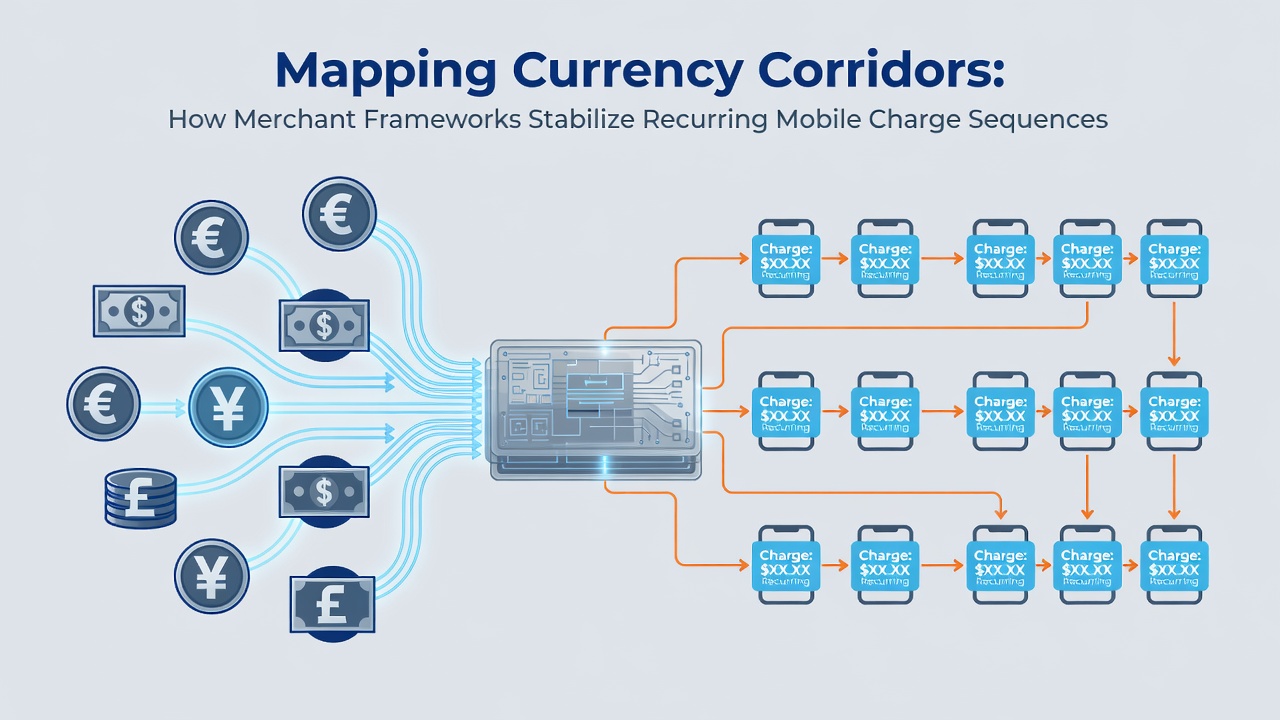
Reconciliation engines close the loop by matching each authorization leg against actual settlement amounts, and any residual differences are posted to variance accounts that the framework clears at month-end. This process operates continuously, and logs generated during June 2026 demonstrated that variance postings stayed below two percent of total corridor volume when frameworks incorporated automated reconciliation triggers.
Integration with Broader Payment Networks
Frameworks connect to card networks and mobile wallet providers through standardized APIs that carry both payment data and corridor identifiers. These identifiers allow downstream processors to apply the correct exchange-rate source without additional queries. Research coordinated by the Reserve Bank of Australia indicates that corridors equipped with redundant API endpoints experience fewer timeouts during peak renewal windows. The same studies document that frameworks sharing corridor definitions across multiple acquiring banks achieve higher throughput because traffic can shift to alternate endpoints when one corridor node encounters congestion.
Security protocols embedded in the frameworks encrypt corridor routing instructions separately from payment credentials, adn tokenization services rotate the routing tokens at regular intervals. This separation prevents any single breach from exposing both the payment details and the corridor mapping logic. Auditors reviewing systems in 2026 confirmed that frameworks using this dual-token approach maintained uninterrupted service for mobile subscriptions even after isolated credential incidents.
Conclusion
Merchant frameworks map and maintain currency corridors that keep recurring mobile charge sequences operational across borders. The frameworks achieve stability through layered reserves, automated conversions, and redundant routing, all coordinated under standardized network rules. Transaction data collected through mid-2026 illustrate that these structures continue to support consistent billing cycles while adapting to shifting exchange conditions and regulatory requirements.