Protocol Frameworks Supporting Uninterrupted Subscription Access in Mobile Commerce Landscapes
Written by Xander Patterson · Jul 28, 2026

Protocol Frameworks Supporting Uninterrupted Subscription Access in Mobile Commerce Landscapes
Network protocols form the backbone that keeps subscription services running smoothly across handheld devices in commerce environments, where users expect constant access without interruptions from connectivity shifts or device mobility. Data from industry reports indicate that handheld commerce transactions rely on layered protocol stacks including transport, session, and application layers to maintain session states during movement between cell towers or Wi-Fi networks. Researchers have documented how these protocols handle packet loss, latency variations, and handoffs while preserving billing cycles and content delivery streams for ongoing subscriptions.
Core Transport Mechanisms in Portable Retail Networks
TCP and UDP variants adapted for mobile use manage the reliable delivery of subscription renewal signals and content updates, with TCP providing ordered packet sequencing that prevents duplicate charges or missed notifications during network congestion. Studies from the GSMA reveal that optimized TCP congestion control algorithms have supported a 25 percent reduction in session drops for mobile subscription platforms between 2024 and 2025, particularly in dense urban areas where device density strains shared spectrum resources. UDP serves lighter tasks such as heartbeat messages that confirm device presence without the overhead of full handshakes, allowing quick recovery when a user moves from one coverage zone to another.
QUIC protocol implementations have gained traction since their standardization because they combine transport and encryption functions into a single layer, reducing the round trips needed to reestablish connections after temporary signal loss. Observers note that QUIC's stream multiplexing feature lets multiple subscription-related data flows operate independently, so a video stream update continues even if a separate billing acknowledgment packet encounters delay. In July 2026 several carriers began rolling out enhanced QUIC extensions tailored for commerce applications, enabling faster state synchronization between handheld terminals and backend servers during high-mobility scenarios.
Session Persistence Through Application Layer Adaptations
HTTP/3 built on QUIC further sustains subscription continuity by allowing servers to push updates proactively rather than waiting for client polls, which proves useful when devices operate on intermittent connections common in handheld retail environments. Evidence from academic papers at institutions in the European Union shows that HTTP/3 adoption correlates with improved continuity metrics, as servers can maintain virtual sessions across IP address changes without requiring full re-authentication. MQTT protocols, originally designed for constrained devices, handle lightweight publish-subscribe patterns that keep subscription status synchronized across fleets of handheld units used by field sales teams.
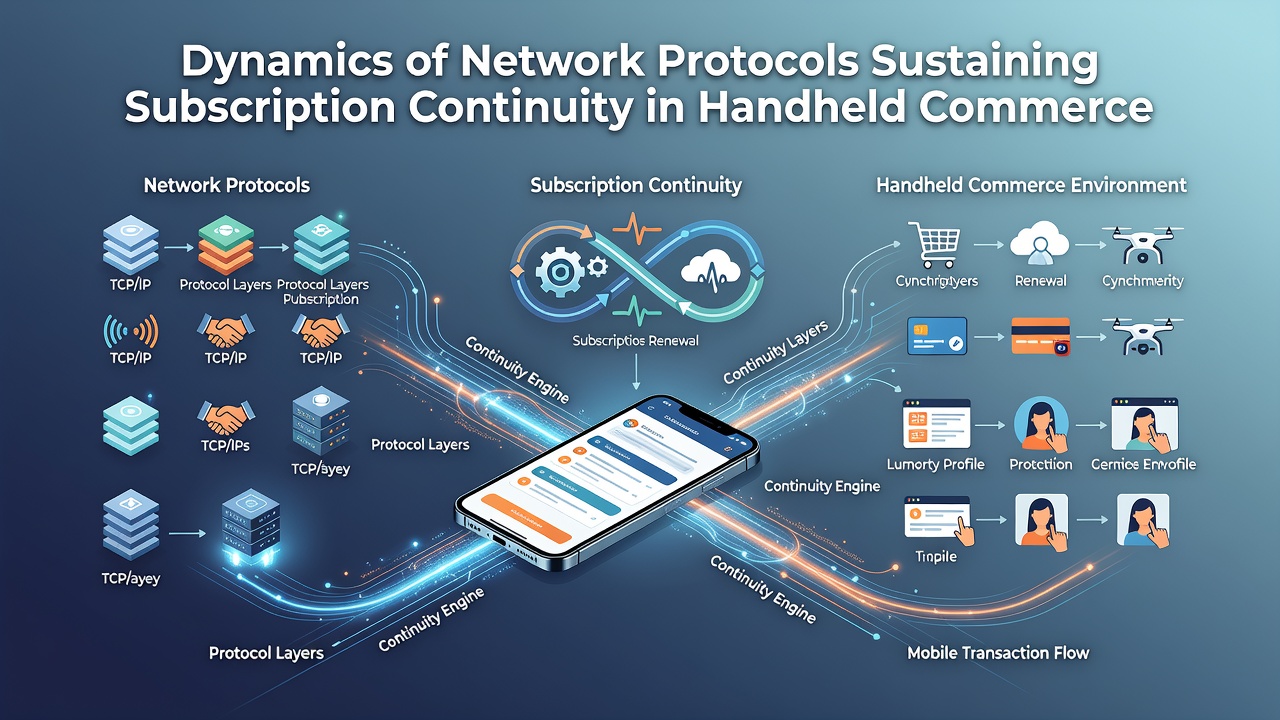
Those who have examined large-scale deployments report that MQTT brokers positioned at edge nodes reduce latency for renewal confirmations, ensuring that a subscription remains active even when the primary cloud path experiences temporary outage. CoAP provides an alternative for ultra-low-power handheld devices, using compact headers that conserve battery while still supporting observe options that notify clients of state changes in subscription records.
Integration With Emerging Wireless Standards
5G network slicing allocates dedicated resources for commerce traffic, separating subscription management flows from general browsing to guarantee consistent performance metrics. Figures released by the Australian Communications and Media Authority indicate that network slicing implementations have maintained 99.7 percent uptime for mobile subscription services in tested regions during 2025 field trials. Handover procedures between 5G and legacy 4G cells incorporate protocol-aware buffering that prevents data loss during transitions, preserving the sequence numbers critical for accurate recurring charge processing.
Observers tracking developments in Canada have seen the CRTC reference similar slicing approaches in regulatory guidance documents, noting their role in supporting continuous service across diverse geographic coverage areas. These mechanisms rely on signaling protocols such as Diameter and GTP to exchange subscriber context between core network elements, allowing seamless continuation of active sessions without user intervention.
Conclusion
Protocol dynamics in handheld commerce ultimately hinge on coordinated behavior across multiple layers that detect, adapt to, and recover from connectivity disruptions while keeping subscription states intact. Research compiled by various standards organizations and regulatory bodies continues to refine these interactions, with implementations scheduled for broader deployment after July 2026 focusing on further latency reductions and energy efficiency gains. The resulting infrastructure supports reliable service delivery for mobile users who depend on uninterrupted access to recurring digital offerings.